Free Instrument Rating guide

Instrument Rating Checkride Oral Exam Guide: What to Expect & How to Prepare

A free ACS-based guide to what to expect during the Instrument Rating oral. Prepare for scenario-based IFR discussion, explain your decisions, and identify areas that need more review.

Practice the conversation, not just the answers.

Get the Free Guide

Free CheckrideIQ account required

Start a Practice Session

3 free 5-minute Discovery Flight sessions
No credit card required

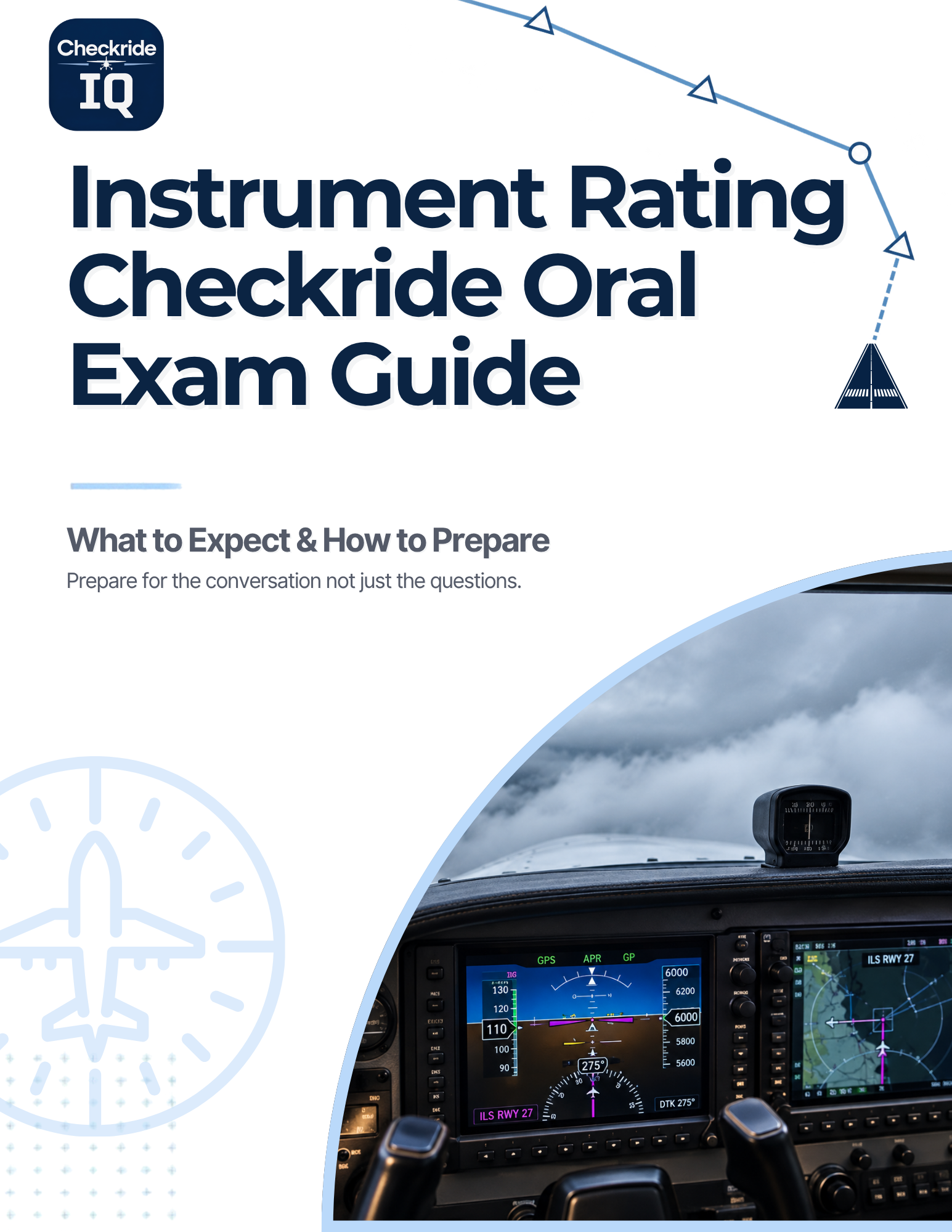
Instrument Rating Checkride Oral Exam Guide cover
Guide page 2: What to expect during the oral examGuide page 17: Build your checkride prep planGuide page 7: Weather scenario question

Your take-with-you companion

What's Inside the Free Guide

A 22-page Instrument Rating Checkride Oral Exam Guide to keep alongside your preparation. It brings the expectations, key knowledge areas, answer frameworks, and preparation timeline together in one practical companion you can save and reference as you prepare.

Know what to expect
The oral's flow, what to bring, pilot qualifications and eligibility, and KNOW → APPLY → EVALUATE → EXPLAIN.
Prepare the core knowledge
Qualifications and currency, IFR equipment, weather, planning, alternates, procedures, navigation systems, and risk management.
Build stronger answers
Understand the question behind the question, handle follow-ups, structure your answers, and practice the conversation.
Follow a preparation timeline
90 / 60 / 30 / 14 / 7 / 3-day preparation milestones, with official FAA resources for continued study.
Get the Free Guide

Free CheckrideIQ account required

What to expect

The instrument oral goes beyond factual recall

The oral portion of the practical test is a structured conversation. Your evaluator is working through the Airman Certification Standards, evaluating how you apply knowledge to an IFR flight, recognize and manage risk, and explain the reasoning behind your decisions.

Questions rarely stand alone. An initial question often develops through follow-ups: conditions change, a system fails, weather moves in. The evaluator is watching how you think, not just what you remember.

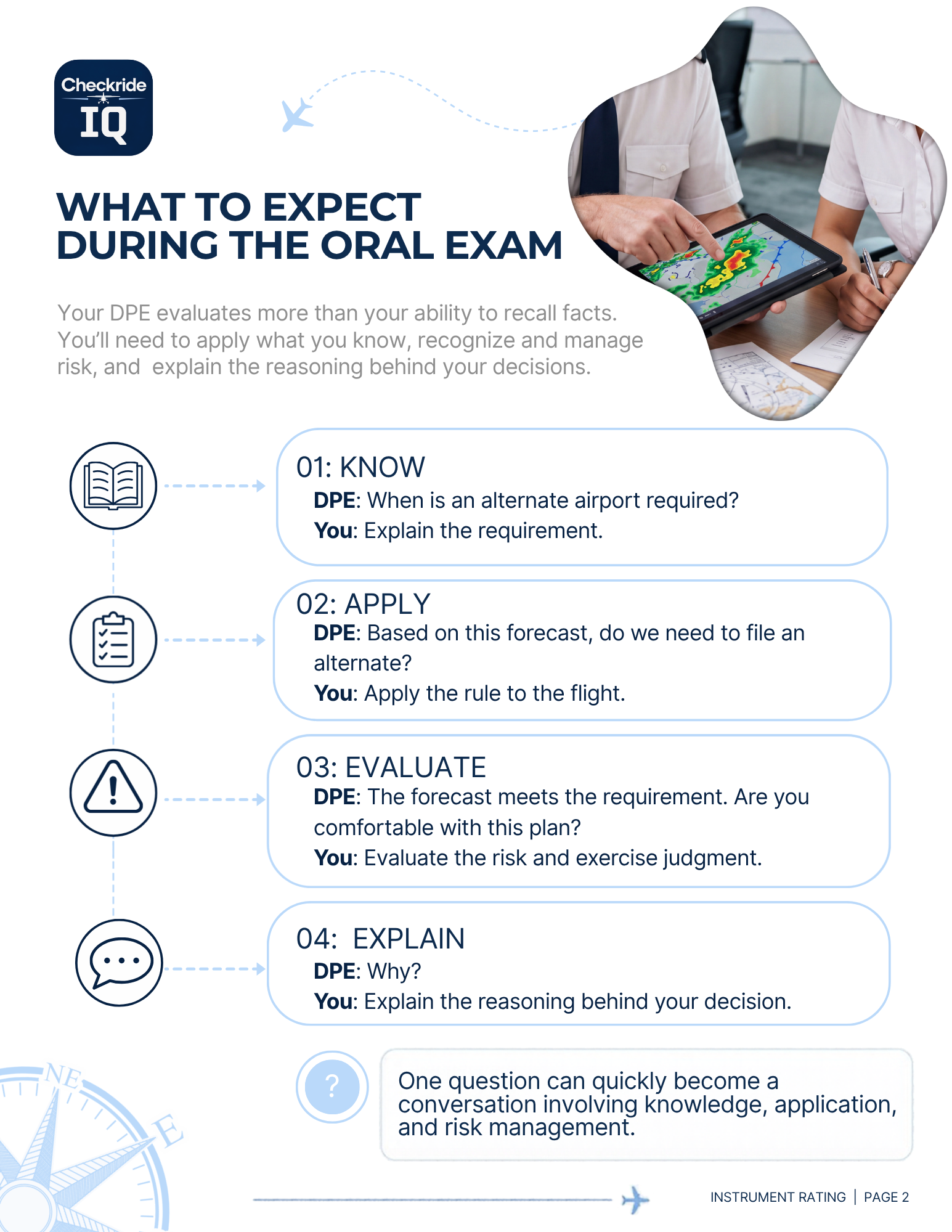
A useful way to think about how questions develop: an illustrative preparation model, not a script every examiner follows:

  1. 01

    Know

    DPE: When is an alternate airport required?

    Applicant: Explain the requirement.

  2. 02

    Apply

    DPE: Based on this forecast, do we need to file an alternate?

    Applicant: Apply the rule to the flight.

  3. 03

    Evaluate

    DPE: The forecast meets the requirement. Are you comfortable with this plan?

    Applicant: Evaluate the risk and exercise judgment.

  4. 04

    Explain

    DPE: Why?

    Applicant: Explain the reasoning behind the decision.

How the oral works

Documents, qualifications, and the flow of the day

Before the questioning starts, the evaluator confirms you are eligible for the Instrument Rating practical test. Review your pilot certificate, identification, applicable medical eligibility, instrument training and experience, endorsements, logbook, and practical-test documentation with your instructor. Distinguish eligibility for the test from instrument currency and proficiency for later IFR operations.

This is educational orientation, not a substitute for current FAA regulations, ACS requirements, endorsements, or your examiner's instructions. Confirm the specifics with your instructor before test day.
Paperwork first

Identity, eligibility, endorsements, and logbook are verified before the scenario discussion begins.

A planned flight

You are typically asked to plan a cross-country flight in advance. Much of the oral hangs off that plan.

A developing conversation

Questions build on your answers. Expect 'what if' variations on the flight you planned.

The framework

Start with the Instrument Rating – Airplane ACS

FAA-S-ACS-8C, Instrument Rating – Airplane Airman Certification Standards, is the framework for your preparation and practical test. For each task, it defines what you must demonstrate across three dimensions: knowledge (what you understand), risk management (what you can anticipate and mitigate), and skills (what you can do).

That structure is why memorizing isolated answers is not enough. Any ACS topic can become a scenario-based conversation: a forecast becomes an alternate-planning decision; an approach procedure becomes a discussion of aircraft capability, minimums, and missed-approach options.

Study the ACS directly (it is linked in the FAA resources section below) and use it as your preparation checklist.

Key knowledge areas

Key instrument oral areas to prepare

Use these topics to organize IFR study around your aircraft and planned flight. This is not an exhaustive list of ACS tasks or possible examiner questions.

Pilot qualifications, currency & proficiency

Know the qualifications and endorsements for your practical test. Distinguish instrument currency from proficiency, discuss how you maintain both, and evaluate your personal readiness with your instructor.

Aircraft airworthiness & IFR equipment

Explain the inspections, documents, required equipment, and inoperative-equipment decisions applicable to your aircraft and planned IFR operation. Verify details using current regulations and your POH/AFM.

IFR weather & decision-making

Build a complete weather picture: observations, forecasts, hazards, trends, and uncertainty. Connect icing, convection, ceilings, visibility, and winds to the route, aircraft capability, and your options.

IFR cross-country flight planning

Connect routes, altitudes, terrain, fuel, performance, destination forecasts, alternates, and escape options. Explain why your plan works and what would make you change it.

Airspace, ATC & clearances

Practice interpreting IFR clearances, communication expectations, route or altitude changes, and airspace implications. Apply the applicable rules and procedures to the flight rather than reciting definitions.

Departures, arrivals & approaches

Review applicable charts, procedure notes, restrictions, minimums, and missed approaches. Explain how you would brief, verify, and use a procedure with your aircraft's equipment.

Instruments, navigation & failures

Understand your aircraft's flight instruments, navigation systems, avionics, limitations, and abnormal indications. Discuss failure recognition, remaining capability, and appropriate actions using aircraft-specific sources.

Performance, limitations & loading

Use your POH/AFM to evaluate aircraft performance, weight and balance, fuel, and limitations. Explain how loading, weather, and changing conditions affect the feasibility of your plan.

Risk management & personal readiness

Evaluate fatigue, stress, recent experience, proficiency, external pressures, and personal minimums honestly. A legal flight is not automatically a prudent flight; bring unresolved questions to your instructor.

Scenario questions

The question behind the question

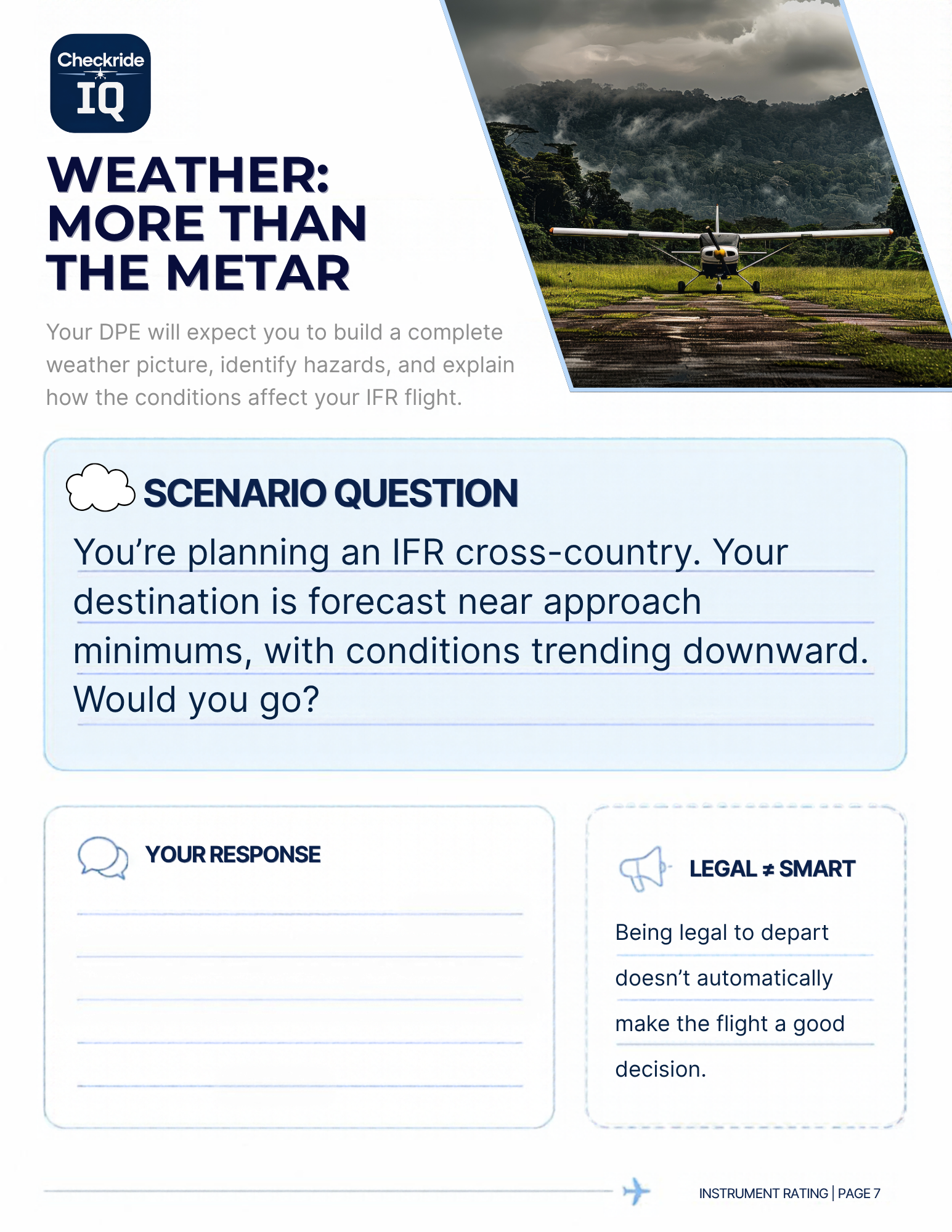
An initial question may lead to a discussion about changing conditions, alternatives, and risk. Consider this illustrative IFR scenario:

“You’re planning an IFR cross-country flight. Your destination is forecast near approach minimums, with conditions trending downward. Would you go?”

Look beyond whether departure is legal. Evaluate the weather trend, alternatives, personal minimums, aircraft capability, fuel, and the consequences of losing your preferred option.

LEGAL ≠ SMART

Being legal to depart doesn’t automatically make the flight a good decision.

  1. Initial question
  2. Follow-up
  3. Scenario changes
  4. Risk evaluation
  5. Decision and explanation

Listen for what the evaluator is actually testing. Beneath almost any question, they are probing some combination of: knowledge, application, risk recognition, prioritization, decision-making, and communication.

No one can predict the exact questions your evaluator will ask, and you should be suspicious of anyone who claims otherwise. What you can do is become fluent in the way questions develop.

Answering follow-ups

The first answer may only begin the discussion

“Your destination’s forecast requires you to file an alternate. What makes an airport legal to file as your alternate?” Follow-ups might include: Where would you find the applicable alternate minimums? Even if it is legal, is it a good alternate? Use current FAA sources and applicable procedures rather than a universal numerical shortcut.

  1. 1ANSWER: Start with the question you were asked.
  2. 2APPLY: Connect it to the scenario.
  3. 3EXPLAIN: Show your reasoning.
  4. 4VERIFY: Know where to confirm details using the appropriate FAA source, regulation, or POH/AFM.

Don’t try to sound like a textbook. Your goal is to demonstrate understanding, not recite a memorized paragraph. Pause to think, answer directly, and make your reasoning clear.

Study timeline

A practical preparation timeline

A suggested progression, not a fixed requirement or promise of readiness. Adjust it with your instructor to your training and schedule.

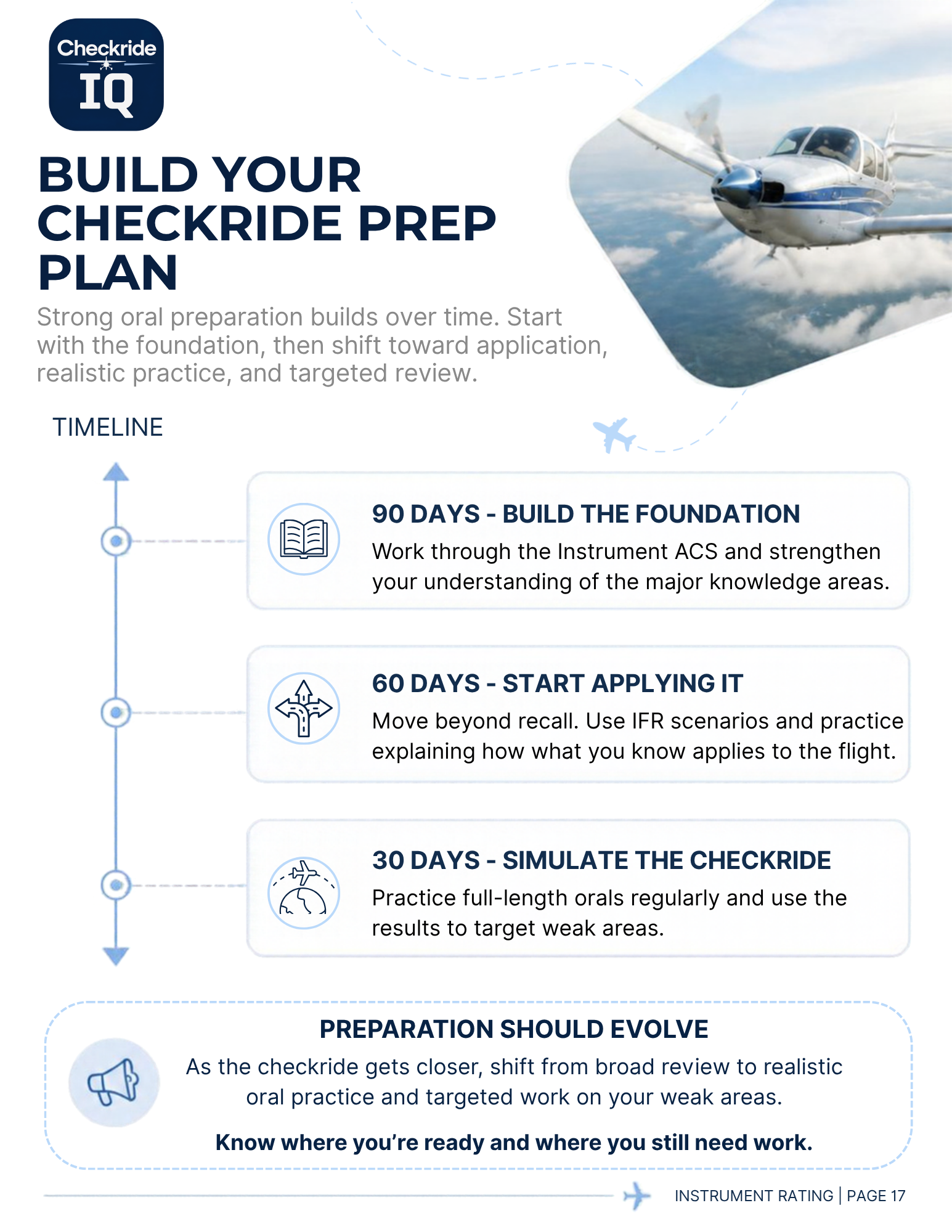
  1. 90 days

    Build the foundation

    Work through the Instrument ACS and strengthen your understanding of the major knowledge areas.

  2. 60 days

    Start applying it

    Move beyond recall. Use IFR scenarios and practice explaining how what you know applies to the flight.

  3. 30 days

    Simulate the checkride

    Practice full-length orals regularly and use the results to target weak areas.

  4. 14 days

    Target the gaps

    Focus on weak areas, recurring mistakes, and topics you haven’t demonstrated consistently.

  5. 7 days

    Build consistency

    Continue realistic IFR oral practice and strengthen areas that still cause hesitation.

  6. 3 days

    Confirm, don’t cram

    Review remaining weak spots, verify important details, and resist the urge to cram.

Practice strategy

Practice the conversation, not just the answers

Say answers out loud. Use realistic IFR scenarios and expect “why?”, “what if?”, and “what would you do next?” Note where you hesitate or struggle to explain your reasoning, then study those areas and discuss unresolved questions with your instructor.

Knowing the answer and explaining the answer are different skills. Combine independent study with instructor-led discussion and repeated practice; none replaces the others.

Where CheckrideIQ fits

One session shows how you performed. Your practice history shows how ready you are.

CheckrideIQ offers text-based DPE-style oral practice with realistic IFR scenarios and follow-up questions that adapt to your responses. Completed sessions include detailed debriefs and ACS-based evaluation.

Individual practice sessions show how you performed in that session. The readiness dashboard uses your practice history to show patterns across ACS areas over time, with each area marked Strong, Needs Review, Weak, or Not Yet Tested. Weak ACS Areas can receive more time in future practice. These Area-level indicators are preparation feedback, not proof of mastery or an instructor endorsement.

Start a Practice Session

3 free 5-minute Discovery Flight sessions
No credit card required

FAQs

Common questions about the Instrument Rating oral

What should I expect during the Instrument Rating checkride oral?

Prepare to apply knowledge to an IFR flight, recognize and manage risk, and explain your reasoning. Questions can develop into follow-ups about weather, procedures, aircraft capability, and changing conditions. These examples are not predictions of any examiner's questions.

What should I study for the Instrument Rating oral exam?

Use the current Instrument Rating–Airplane ACS as your roadmap. Review qualifications, currency, airworthiness, weather, IFR planning, clearances, procedures, navigation systems, failures, and risk management with your instructor and the applicable aircraft references.

Is the Instrument Rating ACS the best place to start?

Yes. FAA-S-ACS-8C identifies the knowledge, risk management, and skills expected for the practical test. Use the current FAA edition to organize preparation rather than trying to predict exact DPE questions.

What kinds of scenario questions might a DPE ask during an instrument checkride?

Illustrative discussions include a destination forecast trending toward approach minimums, selecting a suitable alternate, a changed clearance, or a navigation-system failure. Practice connecting rules, aircraft capability, options, and risk. No list can predict the questions on your test.

Do I need to memorize every IFR regulation for the checkride?

Build working knowledge of the rules relevant to your flight and know where to verify details. Reference use does not replace understanding or required knowledge. Discuss expectations with your instructor and use current regulations, FAA publications, and your POH/AFM.

How should I prepare for questions about IFR weather and alternate airports?

Practice building a complete weather picture, interpreting forecasts and trends, and applying the rules to a planned flight. Check the applicable alternate minimums, procedure notes, equipment requirements, and current FAA sources; legal suitability and a sound backup plan are different questions.

How can I practice explaining IFR decisions instead of just memorizing answers?

Answer out loud, apply the answer to a realistic IFR scenario, explain the reasoning, and identify where you would verify important details. Expect why, what if, and what would you do next. CheckrideIQ offers text-based DPE-style practice and detailed debriefs alongside instruction.

How far in advance should I start preparing for my Instrument Rating checkride?

Start during training and build consistency. The guide suggests foundation work around 90 days out, scenario application around 60 days, and realistic oral practice and targeted review as the test approaches. Adjust the timeline with your instructor; it is not a readiness guarantee.

Is this Instrument Rating oral exam guide free?

Yes. The 22-page Instrument Rating Checkride Oral Exam Guide requires a free CheckrideIQ account, but no paid plan or credit card. Downloading the guide does not use a practice session. It supplements, not replaces, instruction and current FAA and aircraft-specific sources.

Official sources

FAA resources

Ground your preparation in authoritative sources. Verify that you are using current FAA publications, applicable procedure charts and notes, current regulations, and your aircraft’s POH/AFM. Links below go to official FAA or eCFR resources.

Looking for more from CheckrideIQ? See plans and pricing or learn about the team.

Working on your Private Pilot certificate? See the Private Pilot Oral Exam Guide.

Ready to take the next step?

Get the Free Guide

Free CheckrideIQ account required

Start a Practice Session

3 free 5-minute Discovery Flight sessions
No credit card required

A note on this guide

CheckrideIQ is an independent training and preparation resource. It is not affiliated with or endorsed by the FAA. The scenarios and questions on this page are illustrative and are not intended to predict the exact questions any evaluator will ask. Applicants remain responsible for current FAA regulations, ACS standards, aircraft documentation, instructor guidance, and practical-test requirements.